Storage · Guide · ~12 min
NetApp platform: AFF, FAS and ASA
Alterkom – Technology Team. A practical guide to ONTAP and the AFF, FAS and ASA families — when to choose which platform.
NetApp builds a shared data platform spanning on-premises, edge and cloud environments. Its foundation is the ONTAP operating system.
ONTAP provides consistent management, data protection, automation and cloud integration. In the hardware portfolio, the three primary families are AFF, FAS and ASA.
- AFF — unified all-flash arrays for file, block and object workloads;
- FAS — hybrid systems optimised for cooler data, backup, tiering and cyber vault economics;
- ASA — specialised all-flash arrays dedicated exclusively to SAN and block workloads.
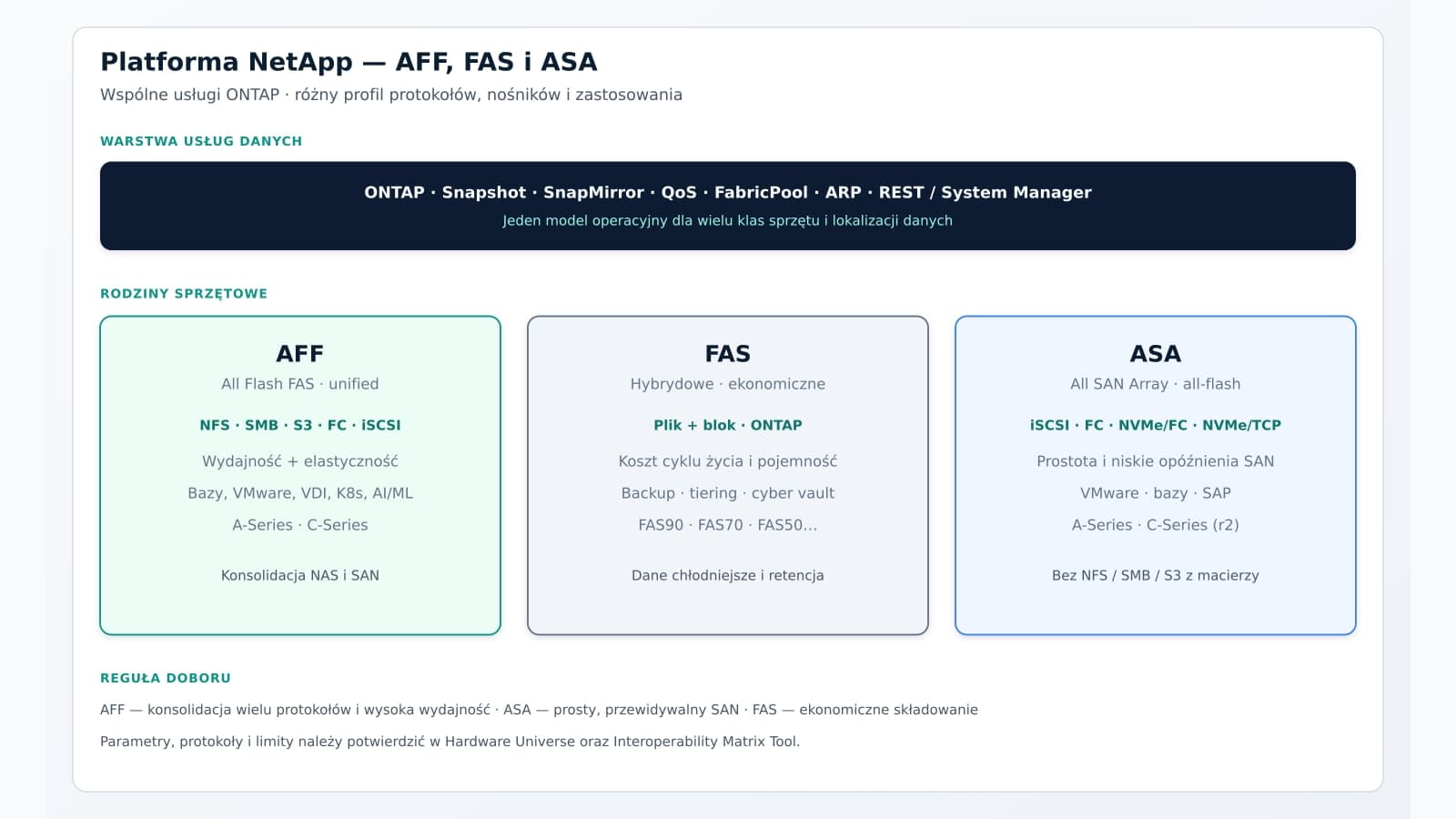
The simplest selection rule: AFF for multi-protocol consolidation and high performance, ASA for simple and predictable SAN, FAS for economical large-capacity storage and data protection.
Table of contents
Availability and cyber resilience
What the NetApp platform is
The NetApp platform is a data infrastructure layer that combines:
- Unified Storage — a shared data model on-premises and in public clouds;
- ONTAP — the operating system and data services set;
- NetApp Console — central fleet and hybrid-service management; this name replaces the earlier BlueXP brand;
- Data Resilience — snapshots, replication, business continuity, cyber vault and ransomware protection mechanisms;
- AI Data Services — discovering, classifying, managing and preparing data for AI solutions.
In practice this means one operational model across many hardware classes and data locations. Not every system supports an identical set of protocols and features. The clearest example is ASA, whose interface and data model are simplified for SAN.
ONTAP — the shared foundation
ONTAP abstracts the hardware layer and gives administrators a consistent feature set. Key concepts include:
- cluster — a group of nodes operating as one jointly managed system;
- HA pair — two controllers that take over for each other after a failure;
- SVM (Storage Virtual Machine) — a logical data server with its own protocols, interfaces and policies;
- local tier / aggregate — a pool of physical media from which logical space is allocated;
- FlexVol / FlexGroup — logical data containers for NAS or SAN workloads;
- LUN / namespace — a block storage unit presented to a host;
- storage unit and consistency group in ASA r2 — a simplified model for presenting and protecting SAN application data.
Key ONTAP services:
- Snapshot — a local read-only point-in-time image that mainly records changes and usually has a small capacity overhead;
- SnapMirror — replication to a second system or site for DR, backup and migration;
- SnapMirror active sync — synchronous protection for block applications and continuous availability between sites;
- FlexClone — fast, space-efficient data clones;
- FabricPool — policy-based movement of cooler data blocks from a performance tier to an object tier;
- deduplication, compression and compaction — reducing the physical data footprint;
- QoS — controlling and isolating workload performance;
- Autonomous Ransomware Protection — detecting unusual activity and supporting incident response;
- SnapLock and immutability mechanisms — protecting data from modification or deletion according to retention policy;
- REST API, CLI and System Manager — automation and operational management.
AFF, FAS and ASA compared
Supported protocols, cluster limits and features depend on model, ONTAP version, I/O cards and the interoperability matrix.
| Cecha | AFF | FAS | ASA |
|---|---|---|---|
| Główne przeznaczenie | Wysokowydajna, zunifikowana pamięć masowa | Ekonomiczne składowanie, backup, tiering, cyber vault | Uproszczona pamięć blokowa SAN |
| Nośniki | SSD / NVMe, all-flash | Konfiguracje hybrydowe i dyskowe, zależnie od modelu | SSD / NVMe, all-flash |
| Protokoły | NFS, SMB, S3, FC, iSCSI; w wybranych modelach także NVMe/FC | Obsługa plikowa i blokowa w modelu ONTAP | iSCSI, FC, NVMe/FC i NVMe/TCP w systemach ASA r2 |
| Typowe obciążenia | Bazy danych, wirtualizacja, VDI, Kubernetes, AI/ML, konsolidacja NAS/SAN | Backup, retencja, dane chłodniejsze, repozytorium DR i cyber vault | VMware, bazy danych, SAP, krytyczne aplikacje SAN |
| Priorytet projektowy | Wydajność plus elastyczność protokołów | Koszt cyklu życia i pojemność | Prostota, niskie opóźnienia i dostępność SAN |
| Serie | AFF A-Series i AFF C-Series | FAS90, FAS70, FAS50 oraz wybrane modele niższych klas | ASA A-Series i ASA C-Series |
| Kiedy nie wybierać | Gdy potrzebny jest wyłącznie prosty SAN albo najtańsza warstwa pojemnościowa | Gdy wymagane są minimalne opóźnienia all-flash | Gdy wymagane są NFS, SMB lub S3 z tej samej macierzy |
AFF, FAS and ASA families on a shared platform
NetApp AFF
Characteristics
AFF, or All Flash FAS, is a family of unified all-flash arrays. The same cluster can serve block, file and — within a defined scope — object data. AFF is a strong choice when an organisation wants to consolidate workloads without building separate SAN and NAS silos.
AFF A-Series
The A-Series is optimised for high performance and low latency. Typical use cases include:
- critical Oracle, Microsoft SQL Server and SAP HANA databases;
- large VMware and VDI environments;
- Kubernetes clusters and stateful applications;
- analytics and AI/ML processing;
- consolidating workloads that need high IOPS and throughput.
The portfolio verified in November 2026 includes AFF A1K, A90, A70, A50, A30 and A20. For the largest configurations the vendor quotes up to 24 nodes, up to 40 million IOPS and up to 1 TB/s throughput. These are maximum values for specific configurations, not guaranteed performance of a single system.
AFF C-Series
The C-Series uses capacity-oriented flash media and is optimised for density and cost per terabyte. Typical use cases include:
- general-purpose workload consolidation;
- large repositories with moderate performance needs;
- Dev/Test environments;
- backup and DR targets when all-flash is required;
- migration from hybrid arrays to flash while preserving capacity economics.
The current family includes AFF C80, C60 and C30. When comparing offers, separate raw, usable and effective capacity. Effective capacity depends on an assumed data-reduction ratio and may not match every data profile.
AFF strengths and limitations
Strengths:
- multi-protocol NAS/SAN consolidation;
- shared ONTAP data services;
- non-disruptive scaling and data mobility;
- integrations with virtualisation, containers and cloud;
- rich protection and recovery mechanisms.
Limitations and design risks:
- a broad feature set may be unnecessary in a block-only environment;
- performance depends on controllers, drives, front-end and back-end networks and workload characteristics;
- declared effective capacity is not guaranteed usable capacity for arbitrary data;
- ONTAP S3 features do not replace a dedicated object platform such as StorageGRID in every scenario.
NetApp FAS
Characteristics
FAS is a family of hybrid ONTAP-based systems. The priority is storage economics and shared management with the rest of the NetApp environment. FAS fits well where part of the data does not require all-flash performance.
Typical use cases
- automatic tiering of less frequently used data;
- backup repository aligned with a 3-2-1 architecture;
- a second protection tier for AFF or ASA systems;
- a logically isolated cyber vault;
- long-term retention and large file datasets;
- environments with a predictable, moderate performance profile.
The current product line presented by NetApp includes FAS90, FAS70, FAS50, FAS2820 and FAS2750. They differ in scale, drive count and maximum capacity; all run ONTAP.
FAS strengths and limitations
Strengths: shared operational model with AFF, lower cost for cooler data, backup and tiering integration, and suitability as a cyber vault tier.
Limitations: lower and less predictable performance than all-flash systems, greater sensitivity to random I/O profiles, and the need to place data correctly across tiers.
NetApp ASA
Characteristics
ASA, or All SAN Array, is an all-flash family specialised for block data. ASA r2 systems have a simplified ONTAP interface and a management model tailored to SAN administrators. They are not intended to serve NFS, SMB or S3.
ASA r2 supports FC, iSCSI, NVMe/FC and NVMe/TCP. A symmetric active-active architecture lets hosts use all paths as active and optimised, simplifying multipathing and load balancing.
ASA A-Series and C-Series
- ASA A-Series — high performance, consistent sub-millisecond latency and critical transactional applications;
- ASA C-Series — high capacity density for block backup repositories, DR and modernising older hybrid environments.
The vendor positions ASA as a way to simplify provisioning, protection and hypervisor integration. Claims such as 100% availability, a 4:1 efficiency guarantee and ransomware recovery guarantees are subject to separate programme terms. They should not be treated as unconditional technical attributes of every deployment.
When ASA instead of AFF
Choose ASA when:
- all primary workloads are block;
- the team wants the simplest possible SAN operating model;
- symmetric active-active paths are essential;
- the environment is dominated by VMware, SAP or databases;
- there is no requirement to share the array between NAS and SAN.
Choose AFF when NFS, SMB, S3 and block protocols must run on one platform, or when unified-storage flexibility matters more.
Availability and cyber resilience
The NetApp platform combines several protection layers:
- Controller HA — failover within a pair;
- Snapshots — frequent local recovery points;
- SnapMirror — a copy on a second system or site;
- SnapMirror active sync / MetroCluster — continuity aligned with RPO and RTO requirements;
- SnapLock and snapshot locking — protection against deletion according to policy;
- Autonomous Ransomware Protection — anomaly detection in the storage layer;
- cyber vault — an isolated, controlled copy for post-incident recovery;
- encryption, RBAC, MFA and multi-admin verification — reducing the risk of administrative takeover.
A snapshot is not a full backup by itself, and HA does not replace DR. A sound design combines local resilience, an independent data copy, tested recovery procedures and monitoring.
Cloud, virtualisation and container integration
ONTAP also runs in software-defined and cloud models, and NetApp services are available natively with major cloud providers. That simplifies replication, migration and consistent data policies in a hybrid environment.
Key integrations include:
- VMware tooling and management from the virtualisation environment;
- SnapCenter for application-consistent protection of databases and apps;
- NetApp Trident for dynamic volume provisioning to Kubernetes;
- REST interfaces and Infrastructure as Code automation;
- NetApp Console for observing and managing hybrid services.
Trident capabilities and data-protection scope depend on version and system type. For example, ASA r2 has its own matrix of supported protocols and operations, so a container project must check current documentation.
How to choose an array family
Scenario A: shared platform for NAS, SAN and containers
Most often AFF. It provides multiple protocols, high performance and the full ONTAP data-services set.
Scenario B: SAN only for VMware and databases
Most often ASA. Simplified operations, active-active paths and modern SAN protocols matter more than multi-protocol flexibility.
Scenario C: backup, long-term retention and cyber vault
Most often FAS when cost per TB matters more than latency. For an all-flash requirement, consider AFF C-Series or ASA C-Series depending on protocol.
Scenario D: AI/ML and very high throughput
AFF A-Series can serve many AI environments, and AFF A90 is certified for NVIDIA DGX SuperPOD. For the largest specialised AI factories NetApp also offers the AFX architecture, covered in a separate article.
Pre-project question list
- Is the workload file, block, object or mixed?
- What peak IOPS, throughput and latency are required?
- What share of data is amenable to deduplication and compression?
- What RPO and RTO apply to each application?
- Are two active-active sites required?
- What expectations exist for immutability, cyber vault and ransomware recovery?
- Will data be moved or tiered to the cloud?
- Does the environment include Kubernetes, VMware, SAP or specific databases?
- Does the organisation prefer purchase, Keystone subscription or a hybrid model?
- Which OS, hypervisor, HBA, switch and protocol versions are supported in the IMT?
Common misconceptions
- AFF and ASA are not the same. Both families are all-flash, but AFF is unified while ASA is SAN-specialised.
- FAS does not mean slow archive-only storage. It still runs ONTAP and can serve production protocols, but its main advantage is economics.
- Effective capacity is not physical capacity. It depends on data reduction and stated assumptions.
- A snapshot does not replace an independent backup. It is one element of a protection strategy.
- Vendor guarantees have terms. They may require specific configuration, licensing, monitoring and operational procedures.
- The BlueXP name is historical. In current materials the management platform appears as NetApp Console.
Sources and further reading
[2] NetApp AFF
[3] NetApp FAS
[4] NetApp ASA
[5] ONTAP data management software
[9] NetApp Interoperability Matrix Tool
Authored from official NetApp materials. Confirm parameters, limits and warranty terms before design or purchase.
Related catalogue products
Selected NetApp arrays and storage used in storage projects — selection depends on protocols, capacity and SLA.
Related business areas
Topics related to storage design and data protection.


Read also
Other materials from the Knowledge section.
Wysoka dostępność serwerów – jak zapewnić ciągłość działania infrastruktury IT?
Klastry HA, redundancja, RPO/RTO i Disaster Recovery — bez mylenia HA z backupem.
Czytaj więcej
Cyberbezpieczeństwo w firmie – jak skutecznie chronić infrastrukturę IT?
Wielowarstwowa ochrona, ransomware i praktyczna strategia bezpieczeństwa.
Czytaj więcej
Kubernetes na Proxmox VE – własna platforma aplikacyjna
Warstwy architektury, sieć, storage CSI i droga od pilotażu do produkcji.
Czytaj więcejChoose a NetApp platform with Alterkom
We help compare AFF, FAS and ASA, plan protocols and data protection, and define a migration path aligned with workloads and SLA.
Recommended by Alterkom
Solutions, focus areas and products related to this article — a path into our offer.